

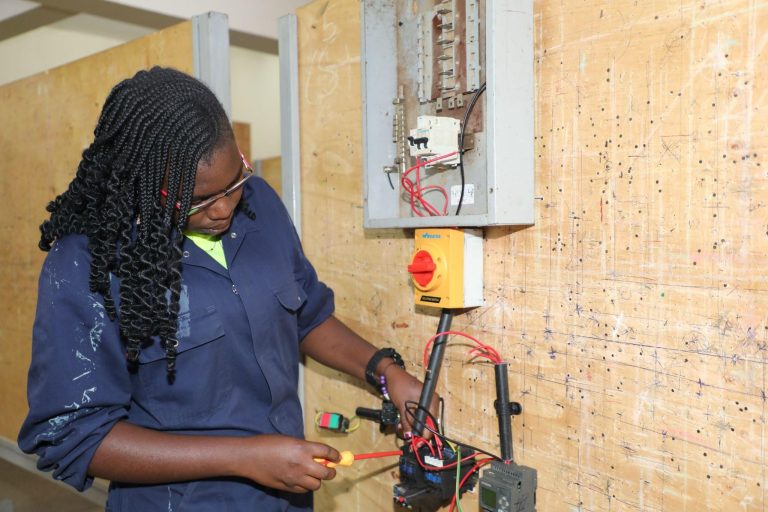
In the buzzing workshops of Meru National Polytechnic, amid the crackle of soldering irons and the steady hum of machines, 22-year-old Frida Gacheri is quietly rewriting expectations. A trainee in Electrical Engineering Level 6, Frida embodies the new wave of young women daring to enter male-dominated technical fields and thriving.
Her path here was far from straightforward. Growing up in a modest household, higher education once felt out of reach. “There were days I thought I’d never get past primary school,” she recalls. “The financial burden was immense, and the expectations for girls in my village were clear: you married young. Engineering was not for us.”
That narrative began to change with the arrival of the East Africa Skills for Transformation and Regional Integration Project (EASTRIP). Through scholarships and targeted outreach, EASTRIP not only lifted the financial weight off her family but also encouraged girls like Frida to imagine themselves as engineers, scientists, and innovators.
“The EASTRIP scholarship was a game-changer,” she says, smiling. “It allowed me to focus fully on my studies. I even had the chance to showcase my project on change-over switches—devices that keep power flowing by switching between the grid and backup generators—to the EASTRIP team. Getting feedback from industry experts was incredible.”
Support at Meru National Polytechnic went beyond funding. Mentorship became a lifeline. For Frida, that meant the guidance of Grace Gakii, the Women in Technical Education and Development (WITED) coordinator and a seasoned Electrical Engineering trainer. “Madam Grace has been more than just a trainer; she’s been a mentor and inspiration,” Frida says.
Gakii, in turn, describes Frida as “a testament to what passion and perseverance can achieve,” praising her drive and hunger to learn.
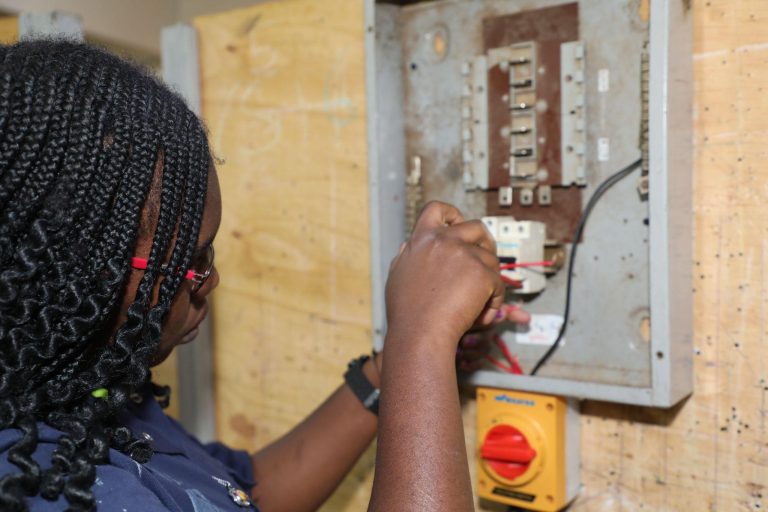
The combination of mentorship, hands-on training, and industry linkages through Meru Polytechnic’s dual training model has given Frida a clear edge. She excelled in circuit design and problem-solving, landed valuable internships, and gained practical experience that makes her highly employable. Her success has rippled back home, where younger girls now approach her with curiosity about STEM. “When I go back, girls ask me about my studies,” she says with pride. “They see it’s possible for them too.”
The Chief Principal of Meru National Polytechnic, Mutembei A. Kigige, OGW, sees stories like Frida’s as proof of progress. “We’ve seen a significant rise in female enrolment in technical courses, especially engineering,” he notes. “This is the direct result of targeted support from EASTRIP and our commitment to inclusive education.”
Frida now looks ahead with confidence. “I’ve learned that with determination and the right support, any barrier can be overcome,” she reflects. Her dream is to use her skills to innovate, serve her community, and inspire more girls to push past limitations.
Her journey underscores a simple truth: when women are given opportunities in technical education, they not only transform their own lives but also light the way for future generations.


Leave a Reply